Retention ArchitectureApril 7, 20268 min readBy Sean Ward
User Retention Architecture: Why Features Alone Won't Save Your Startup
Learn why user retention architecture matters more than feature volume, and how founders can engineer activation, stored value, and trust into a scalable product.
For most founders and CEOs, the instinctual response to a high churn rate is a call for "more." More features, more integrations, more polish. You look at your roadmap and assume that the reason users are leaving - or failing to activate - is because the product is not "complete" yet.
But for a growing startup, a feature-heavy roadmap is often a distraction from a fundamental structural failure. If your core engine is leaking users, adding more weight will only burn through your runway faster.
I've seen this cycle repeatedly: a team ships a massive new module, sees a temporary spike in "curiosity" logins, and then watches the retention curve resume its downward slide. The problem is not a lack of functionality; it is a lack of User Retention Architecture.
Retention is not a marketing problem, and it is not a UI/UX problem. It is a technical engineering problem. To build a product that scales, you must move beyond building features and start engineering for predictable, long-term growth.
The Feature Fallacy: Why Your Roadmap is Leaking Users
The "Feature Fallacy" is the belief that the next feature will be the one that finally makes the product "sticky." This mindset leads to feature bloat, which increases your technical debt and complicates the user journey without solving the root cause of churn.
When you add features to a fragile prototype, you are not building a product; you are building a liability. Every new feature introduces:
Increased Cognitive Load: Users struggle to find the "aha moment" amidst a sea of options.
Maintenance Drag: Your senior engineers spend more time fixing bugs in secondary features than optimizing the core value proposition.
Diluted Analytics: It becomes impossible to diagnose which specific interaction actually drives long-term retention.
At YochaAI, I advocate for a Retention-First Build Sprint approach. We stop the feature factory and focus on the technical systems that actually keep users coming back.
Defining User Retention Architecture
User Retention Architecture is the deliberate design of technical systems to prioritize user activation, repeat usage, and long-term trust. It is the skeletal structure that supports your product-market fit.
Unlike standard application development, which focuses on capabilities (what the app can do), Retention Architecture focuses on outcomes (what the user achieves). This involves three critical layers:
1. Activation Instrumentation
If a user does not reach the "aha moment" within their first session, they are effectively gone. I engineer systems that track time-to-value (TTV) with surgical precision. This is not just about high-level Google Analytics; it is about custom growth instrumentation that identifies exactly where the friction exists in your onboarding flow.
2. Behavioral Trigger Loops
Repeat usage does not happen by accident. It is engineered through behavioral triggers - notifications, data updates, or social signals - that are baked into the technical architecture. We build systems that recognize when a user is drifting and automatically trigger the right technical response to pull them back in.
3. Stored Value Systems
The most retentive products are those where the user "stores value" over time. Whether it is data, custom configurations, or historical progress, the technical architecture must make it harder for the user to leave than it is to stay.
Business-First Architecture: Aligning Technical DNA with Growth
Your technical architecture must match your unit economics. This is what I call Business-DNA Alignment.
If your business model relies on high-frequency usage (like a B2C app), your architecture must be optimized for low-latency triggers and engagement hooks. If you are selling into the enterprise, your architecture must prioritize security, SSO, and stability to build long-term trust.
When I perform a Retention Leak Audit, I do not just look at your code; I look at your profit margins. A "perfect" codebase that costs too much to maintain relative to its user LTV (Lifetime Value) is a failed architecture.
Case Study: Driving High-Frequency Usage at NSP Soccer
NSP Soccer is a prime example of why technical engagement systems matter. In the competitive world of sports training, retention is driven by habit.
We did not just build a video player for them; we engineered a gamification engine designed for daily activation. By implementing a sophisticated progress-tracking system and position-specific tactical modules, we transformed the product from a static library into a dynamic training partner. The technical architecture was designed specifically to lower the friction of "starting a session," ensuring that users saw immediate value every time they opened the app.
The result? A predictable growth engine that turned casual players into long-term subscribers, currently serving over 6,000 players worldwide.
Case Study: Engineering Enterprise Trust at North GA EMC
In the enterprise and utility space, retention looks different. For organizations like North GA EMC, retention is built on Product Hardening and trust.
When dealing with critical infrastructure and sensitive data, a "fragile prototype" is not just a nuisance: it is a risk. I focused on building an enterprise-grade foundation, prioritizing robust Security and SSO (Single Sign-On) integrations. By hardening the stack and ensuring seamless, secure access, we eliminated the technical friction that often leads to churn in B2B environments.
When the product is stable, secure, and fits perfectly into the existing organizational workflow, the "trust barrier" is removed. That is the essence of Business DNA Architecture.
The Founder-Led Advantage: Senior Engineering Without the Layers
Founders and CEOs do not have time to manage junior developers or navigate the bureaucracy of a traditional agency. When you work with YochaAI, you are working directly with me: a senior engineer who understands that code is only valuable if it generates revenue.
My approach to custom software development for founders is built on direct accountability. There are no project managers, no "hand-offs," and no wasted runway on features that do not move the needle.
I provide:
Diagnose: I identify the technical bottlenecks strangling your growth.
Align: I ensure your tech stack matches your business goals.
Ship: I deliver production-ready code that is built to scale.
Scale: I implement the instrumentation needed to predict and drive future growth.
Conclusion: Stop Building Features, Start Building Engines
If your startup is struggling with churn, the answer is rarely found in the next item on your Trello board. Features alone will not save a startup. Architecture will.
Stop pouring resources into a leaky bucket. Whether you need to stabilize a fragile prototype or build a retention-first engine from scratch, you need an engineering partner who prioritizes your bottom line over technical vanity.
Let's stop the leak and start the growth.
Book a Strategic Roadmap Session today to diagnose your retention architecture and transform your product into a high-performance growth engine.
Ready to stop building a fragile prototype?
If you already see the gap between shipping features and building a real growth engine, I can help you harden the product, instrument the funnel, and turn technical execution into business leverage.
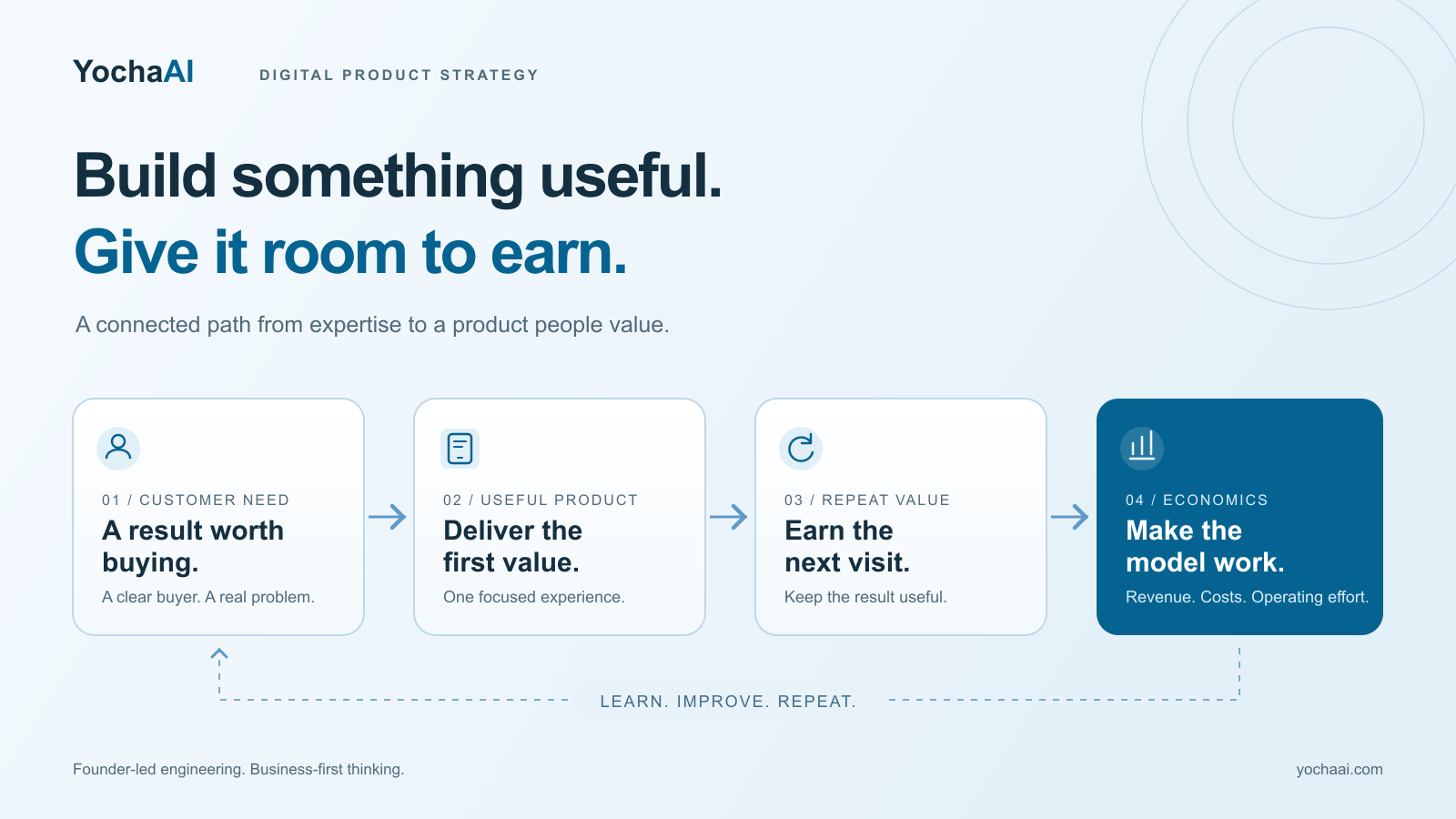
Can an app make money, or even millions? A practical path from your expertise and a customer problem to a useful product, repeat customers, and income that depends less on your time.
Stop Wasting Time on Tech Debt: 5 Product Hardening Hacks for Stability
Tech debt is not just a developer annoyance. It is runway leakage. These five product hardening moves stabilize core flows and reconnect engineering work to revenue.