Founder StrategyFebruary 12, 20266 min readBy Sean Ward
Why a Fractional Founding Engineer Will Change the Way You Build Product-Market Fit
Learn how a fractional founding engineer helps founders harden fragile prototypes, improve retention, and reach product-market fit without the cost of a full-time executive hire.
As a Founder or CEO, you are not looking for "more code." You are looking for a business result. You have likely felt the anxiety of watching your runway disappear while your product remains a fragile prototype that users abandon after one session.
Most startups fail here. Not because the idea is bad, but because the execution is disconnected from the business DNA. You hire a junior team or a generic agency, and you end up with "feature bloat" instead of a revenue-generating engine.
I'm Sean Ward, and at YochaAI, I provide a different path: the Fractional Founding Engineer.
When you work with me, you are not being handed off to a junior developer or a project manager. You are working directly with a senior-level partner who treats your technical architecture as the foundation of your profit margins.
The Senior-Level Advantage: Accountability Without Bureaucracy
In the early stages of a product, every line of code is a business decision. Junior developers focus on how to build a feature; I focus on why that feature exists and whether it helps you reach validated product-market fit.
A Fractional Founding Engineer bridges the gap between high-level vision and production-ready reality. My "Retention-First" execution system is designed to ensure that the software we build does not just work: it scales, it stays stable, and it keeps users coming back.
Here is how I transform fragile prototypes into scalable, revenue-aligned engines.
1. Retention-First Architecture
Most engineering teams focus on shipping features. I focus on keeping users.
Retention-First means designing the technical architecture specifically to improve user activation and long-term trust. If your database schema is not optimized for the way your users actually interact with the product, you will face performance bottlenecks that drive churn.
I diagnose these structural flaws early. I align your technical roadmap with user behavior, ensuring that every deployment hardens the product's relationship with your customers. We do not just ship; we stabilize.
2. Product Hardening: Eliminating the Fragile Prototype
Founders often come to me with a "leaking bucket": a product that has enough features to be interesting but lacks the stability to be professional.
Product Hardening is the process of refining your existing codebase to eliminate feature bloat and ensure enterprise-grade security. I take your MVP and make it "production-ready." This involves:
Fixing Stability Issues: Eliminating the bugs that cause user frustration and churn.
Streamlining Code: Removing unnecessary complexity that slows down future development.
Security Alignment: Ensuring your data architecture is safe and compliant before you scale.
By hardening the product, I protect your runway. You stop spending money fixing the same bugs and start spending it on growth.
You cannot optimize what you do not measure. Many startups fly blind, guessing why users are bouncing.
I implement Growth Instrumentation: advanced tracking and analytics that diagnose exactly where your users are falling off. This is not just about "page views"; it is about deep-level event tracking that informs your business strategy.
With the right instrumentation, your product becomes a diagnostic tool. We can see precisely which features drive retention and which are wasted effort. This allows us to optimize the product for predictable, repeatable growth.
Why "Fractional" is the Smart Play for 2026
Building a startup is an exercise in resource management. Hiring a full-time CTO or Founding Engineer at a senior level can cost $200k+ in salary alone, not to mention equity and overhead.
As a Fractional Founding Engineer, I provide:
Exec-Aligned Strategy: I speak the language of profit, retention, and runway.
Rapid Onboarding: I integrate into your workflow in days, not months.
Direct Ownership: I am the one writing the code and making the architectural decisions. There is no middleman.
Reduced Risk: You get senior-level expertise to de-risk your technical strategy without the long-term commitment of a full-time executive hire.
Stop Building Features, Start Building an Engine
If your product is struggling to retain users, or if you are tired of managing a technical team that does not understand your business goals, it is time to change your approach.
Anyone can build a product. Not everyone can build a revenue-generating engine.
I help founders move past the "fragile prototype" stage to reach a state of validated product-market fit and sustainable growth. We align your technical architecture directly with your business DNA.
Ready to harden your product and fix your retention leaks?
Let's build your strategic roadmap. Reach out today, and let's discuss how I can step in as your Fractional Founding Engineer to turn your vision into a production-ready reality.
Ready to stop building a fragile prototype?
If you already see the gap between shipping features and building a real growth engine, I can help you harden the product, instrument the funnel, and turn technical execution into business leverage.
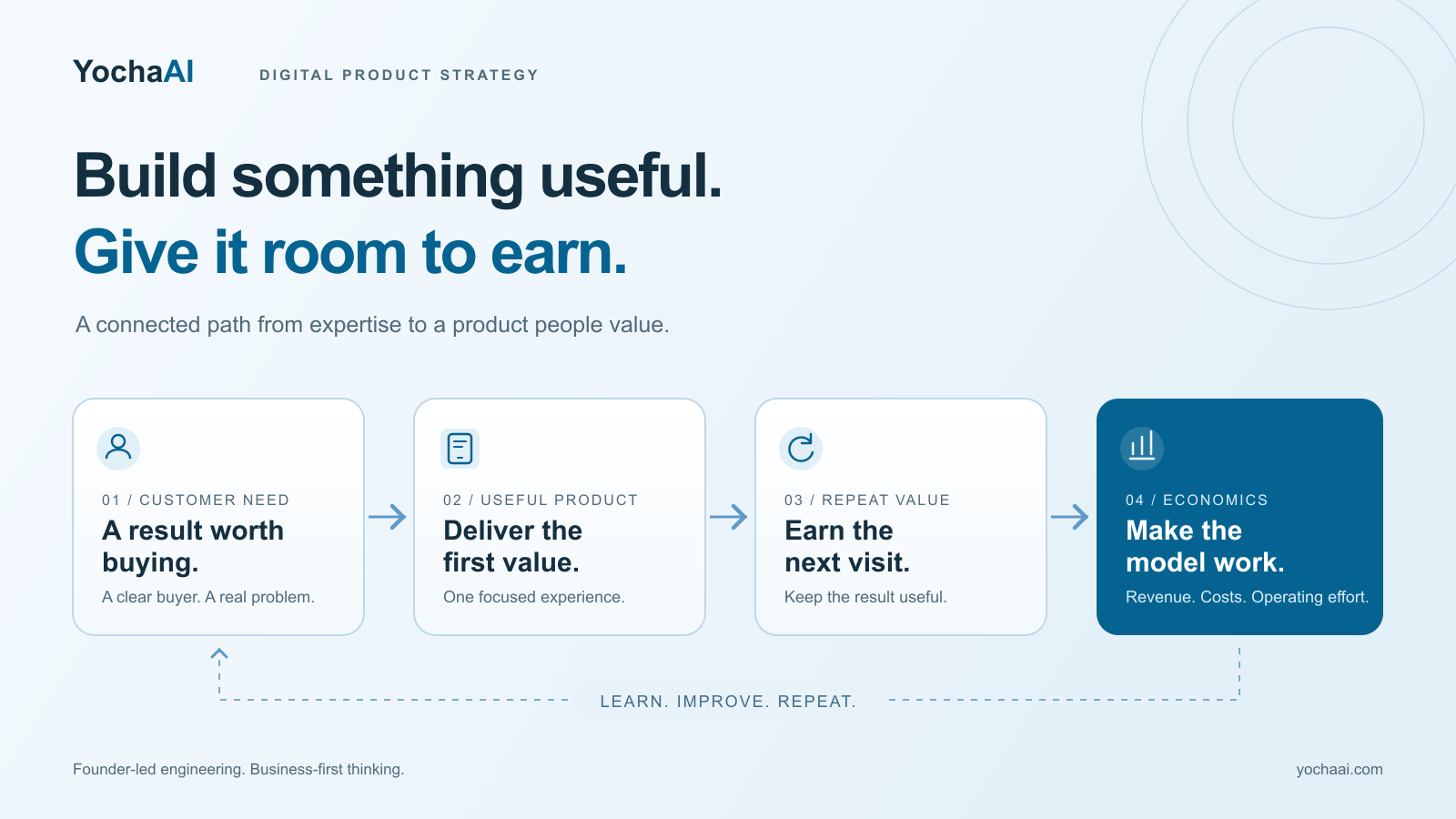
Can an app make money, or even millions? A practical path from your expertise and a customer problem to a useful product, repeat customers, and income that depends less on your time.