Digital Product StrategyOctober 13, 202611 min readBy Sean Ward
The Path to Passive Income Using Digital Products
Learn how to build income with digital products: validate demand, launch a focused app, reach buyers, earn repeat use, and understand the revenue math.
You know something useful. You have solved a problem, developed a method, or spotted a workflow that could be much easier. The question is whether that knowledge could become a product people pay for, even when you are not personally delivering every result.
Digital products can create that kind of income. A template can be sold repeatedly. An app can guide thousands of people through a process. A subscription tool can deliver continuing value. The opportunity grows when the product solves a real problem and the business can reach, serve, and keep its customers.
I am Sean Ward, founder of YochaAI. My work connects product engineering to the business behind it. Here is the path I would use to turn an idea into a digital product with a credible chance of earning its place in customers' lives.
How do I build passive income?
Start with a repeatable result that a specific customer values, validate willingness to pay, and build a system that delivers that result with less of your direct involvement. Then develop a reliable way to reach customers and improve the product from what they actually do.
For a digital product, "passive" describes how much delivery depends on you. Selling a worksheet without running a live session is one example. A guided app that helps customers apply your method is another. As delivery, onboarding, billing, and common support tasks become more repeatable, the business may depend less on your personal hours.
That still leaves work: attracting customers, maintaining software, answering questions, updating content, and managing costs. Recurring revenue is also different from passive income. A subscription can earn every month while requiring substantial effort to keep providing value.
A useful early goal is income that becomes less dependent on your time. Work toward that by making the customer result repeatable, documenting operations, and automating tasks you understand well enough to check.
Start with something you understand
Existing expertise and access to potential customers give you a practical starting point. A coach may understand where clients lose momentum. A trainer may have a method that people already pay to learn. A specialist service business may see the same avoidable problem every week.
A guided practice product: help people apply a method, track progress, and choose the next useful exercise.
An assessment and action plan: help a specific buyer understand a problem and decide what to do next.
A focused workflow tool: help a team complete a recurring task with fewer errors or less manual work.
A digital resource: provide a template, toolkit, or learning product that helps someone achieve a defined result.
Choose one of these possibilities and test demand before investing in the full build. An internal tool that saves your own team time does not automatically become something another business will buy. Find the external buyer and test that separate proposition.
Can I make money with an app?
Yes. An app can generate revenue when customers are willing to pay for the result it delivers, and it can become profitable when revenue covers acquisition, delivery, and the wider costs of running the business.
The model should fit how customers receive value. A one-time purchase can suit a product that delivers a complete, lasting result. A subscription can suit continuing training, regularly updated resources, or a tool used throughout a recurring workflow. A usage-based charge can suit a service whose value and delivery costs change with usage.
Choose the model after understanding the customer. A monthly payment needs a continuing reason to pay. Advertising needs an audience and an advertising business that works. A marketplace needs enough useful activity on both sides. Putting a payment screen into an app does not establish those conditions.
Validate the offer before the large build
Speak with people who experience the problem. Ask about the last time it happened, what they used to solve it, what the workaround cost, and who makes the buying decision. Learn the words they naturally use to describe the difficulty and the result they want.
Then offer a concrete next step: a demonstration, a clearly scoped pilot, a paid first version, or a small manual service that tests the outcome. A compliment, a waitlist signup, a completed pilot, and a payment are different kinds of evidence. Record them separately.
The first version may be a simple web product or a workflow supported by existing tools. If a standard course platform can deliver the whole customer result, that may be enough. Custom software earns its place when the experience, logic, integrations, or repeat use require it.
Can my app make millions?
An app can reach millions in revenue, but an idea alone cannot tell you whether yours will. Start by translating the ambition into a price, a paying customer count, and the work required to reach and keep those customers.
For a real example of scale, Duolingo's 2025 results reported more than 50 million daily active users and over $1 billion in bookings. Those are mature-company figures, and bookings are distinct from revenue and profit. They are not projections for a new product.
For illustration, assume every customer actually pays the full monthly price:
250 paying customers at $20 a month: $5,000 in monthly gross subscription revenue.
5,000 paying customers at $20 a month: $100,000 in monthly gross subscription revenue.
$100,000 a month maintained for 12 months: $1.2 million in annual gross subscription revenue.
These are arithmetic examples, not forecasts or YochaAI client results. Multiplying a current monthly figure by 12 gives an annualized run rate; it does not show what the business has already earned or will earn.
Now ask the operating questions. Where will those customers come from? How many reach the first useful result? How many renew? What does each customer cost to serve? Can the business afford acquisition before the revenue arrives?
Revenue also has to cover refunds, payment and platform fees, hosting, AI usage where applicable, support, marketing, ongoing development, overhead, and taxes on business income. A seven-figure revenue figure can coexist with weak profit or tight cash flow.
If 5,000 customers pay in one month and 250 leave the following month, you need 250 new paying customers just to restore the original count. That hypothetical example shows why retention belongs in the income plan from the beginning.
The milestone to pursue first is a smaller group of customers who reliably get value, pay, and remain affordable to serve. Learn how to repeat that result before treating the million-dollar calculation as a business plan.
Is there a secret to app success?
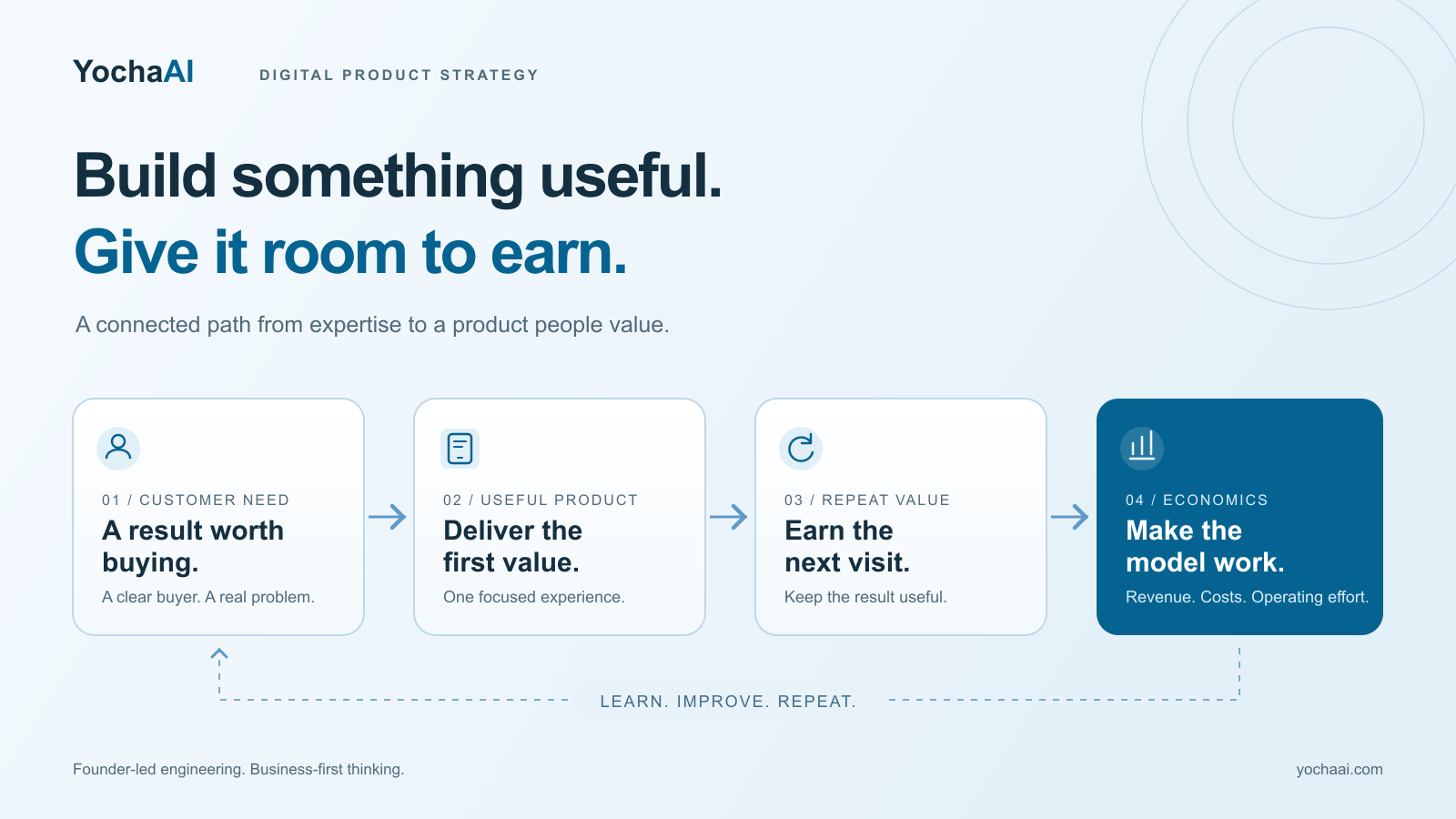
The most useful answer is a connected business system: a clear customer, a valuable outcome, a product that delivers, a route to buyers, repeat value, and economics you can measure.
An app can look polished and still leave customers unsure what to do. A campaign can attract attention and still bring people who do not need the product. A useful product can remain hard to discover. Each part affects the others.
I use retention-first engineering to keep the work tied to that system. The question behind a feature is what it helps someone accomplish and why they would continue using the product. That includes reliability and thoughtful onboarding, as well as the offer, the customer experience, and the business around it.
Product-market fit, in this approach, means a defined group repeatedly receives enough value to choose the product and support a workable business. Downloads, followers, a successful launch day, and a positive ad dashboard can each be useful signals. None establishes the whole picture.
A five-pillar path from idea to evidence
YochaAI's 120-day program organizes the work around five overlapping pillars. Customer conversations and business development continue while the product is being built. Learning from use then shapes the next release and the next commercial decision.
1. The Idea: choose a buyer and a useful result
Define who the product is for, which problem matters enough to solve, and what would make the first version worth trying. Examine existing alternatives and the evidence that someone would pay. The result is a focused hypothesis you can test.
A working statement might be: "This product helps independent coaches turn a client's weekly plan into a guided practice routine the client can actually complete." That is a hypothetical example with a buyer and a result you can investigate.
2. The Build: deliver the smallest useful experience
Your minimum viable product, or MVP, should complete the core customer journey. That may include onboarding, the useful activity itself, payment where appropriate, and enough measurement to understand what happens.
Choose an observable first-value event: a useful assessment completed, a real report exported, or a relevant training session finished. Account creation tells you someone started. The first-value event tells you more about whether the product delivered.
For example, NSP Soccer connects training programs, skill development, and coach workflows in a mobile product. It illustrates product engineering around a continuing customer activity.
3. The Business DNA: build demand alongside the product
Clarify the offer, your voice, and the route to a sale. What changes for the customer? Why is that worth paying for? Where do suitable buyers already look for help? What is the next step you want an interested person to take?
Useful content can support three jobs:
Discovery: explain a recognizable problem so the right people find you.
Understanding: demonstrate a useful method, answer a buying question, or show the product working.
Decision: invite someone to a sample, pilot, trial, purchase, or relevant conversation.
Study the questions and formats that interest your audience, then contribute your own expertise and examples. Use customer language responsibly. Review which content leads to useful conversations, product use, and purchases as well as which posts attract views.
Organic growth takes effort too. Include the time spent publishing, following up, and making sales when judging whether a channel is sustainable.
4. The Adjustment: learn from customers and product use
Invite a small, relevant first group. Watch where people hesitate, ask what they expected, and find out whether they achieved the intended result. Compare those conversations with usage and payment records.
If suitable buyers respond to the offer but struggle during onboarding, improve that journey. If users get a useful first result but do not return, investigate whether they have a continuing need. If nobody wants the offer, revisit the buyer, problem, or proposition.
Use the product's natural rhythm. A tool needed once a month should be judged differently from a daily training app. Compare groups at similar ages; a recently launched group cannot yet demonstrate months of retention.
Make one meaningful change, decide what would count as improvement, and observe it long enough to learn. At low volume, watching users and resolving demonstrated friction can be more useful than treating a tiny percentage change as a firm conclusion.
5. The Sale at Scale: expand what the business can support
Increase reach when the message connects with suitable buyers, the product delivers, and the economics can support additional customers. Paid advertising can then enter through a small test with a spending limit and a decision date.
Follow the path from spend to customer value and collected payments. A low-cost click is promising only if the people arriving can become customers worth serving. Check refunds, support load, retention, and the cash required while waiting for acquisition costs to be recovered.
The Day 120 decision is to expand, keep testing, reposition, or stop. The calendar creates a working rhythm. It does not promise product-market fit, profitable ads, or a particular income by the deadline.
What should you measure before buying more growth?
Use a small set of measures connected to the actual customer journey:
Demand: do suitable buyers take a meaningful next step, and what objections do they raise?
First value: do people complete the activity that produces the promised result?
Continued value: do they use the product again at the relevant interval, renew, or recommend it?
Payment: what was actually collected, refunded, or renewed? Keep free users and trials separate from paying customers.
Customer contribution: after refunds, payment fees, and variable delivery costs, what remains to help cover acquisition, overhead, and profit?
Operating effort: how much manual work and support is needed per customer, and which tasks can safely become repeatable?
Contribution is an intermediate measure, not final profit. You still need to account for acquisition, fixed overhead, development investment, and taxes. The aim is to connect attention, useful behavior, customer payments, and costs so you know which part needs work.
What to do before commissioning the full app
If you are starting with an idea, design, or prototype, prepare a short brief:
Name the buyer. Choose a specific person or team you can reach and learn from.
Describe the problem. Include a real example and the current workaround.
Define the first useful result. Say what the customer should accomplish, rather than list every possible feature.
Record the evidence. Separate assumptions, interview findings, interest, actual use, and payments.
Set the constraints. Identify your available budget, time, delivery responsibilities, and the decision the first test must inform.
As your fractional founding engineer, I can help connect that brief to a practical technical plan, review an existing prototype, and build a focused product. You bring the expertise, customer access, and business decisions. YochaAI leads product design, engineering, testing, and measurement.
A digital product becomes a stronger income opportunity as customer value, delivery, distribution, and economics become repeatable. The next useful step is to test the result someone would buy, then build the business and product around what you learn.
What could your idea or expertise become?
Bring your customer problem, product idea, design, or prototype. We can talk through the buyer, the first useful version, and the evidence to gather before committing to a larger build.
Stop Wasting Time on Tech Debt: 5 Product Hardening Hacks for Stability
Tech debt is not just a developer annoyance. It is runway leakage. These five product hardening moves stabilize core flows and reconnect engineering work to revenue.